Scientific Committee
Our Scientific Committee brings together a global community of experts dedicated to advancing friction stir welding and processing and the wider family of friction and plastic deformation-based processes. True to the FSWP 2027 conference's welcoming spirit, it spans the whole field — entrepreneurial pioneers and scientific authorities alike. Their shared aim is a diverse, high-quality programme that sparks collaboration and mentorship and moves the field forward. Feel free to connect with them during the event.
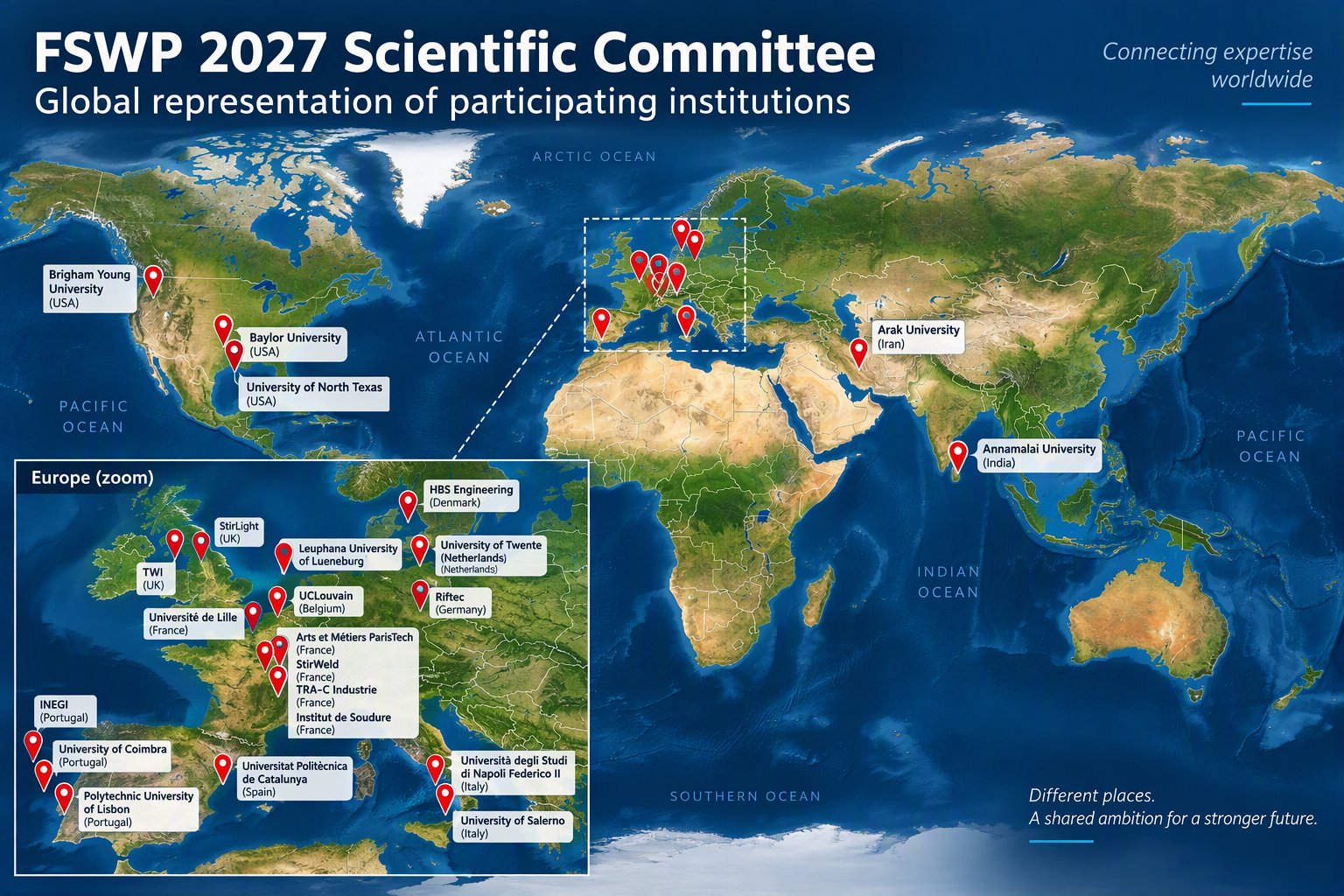
Image created with Co-Pilot
Paul | Allison | Baylor University |
Marie-Noëlle | Avettand-Fènoël | Université de Lille |
Visvalingam | Balasubramanian | Annamalai University |
Reza | Beygi | Arak University |
Ton | Bor | University of Twente |
Pierpaolo | Carlone | University of Salerno |
Sandra | Chevret | Arts et Métiers ParisTech |
Michele | Chiumenti | Universitat Politècnica de Catalunya - Barcelonatech |
Laurent | Dubourg | StirWeld |
Ivan | Galvão | Polytechnic University of Lisbon |
Landry | Giraud | TRA-C Industrie |
Yuri | Hovanski | Brigham Young University |
Elizabeth | Hoyos | TWI |
Brian | Jordon | Baylor University |
Benjamin | Klusemann | Leuphana - University of Luneburg |
Carlos | Leitão | University of Coimbra |
Axel | Mayer | Riftec |
Rajiv | Mishra | University of North Texas |
Pedro | Moreira | INEGI |
Hugo | Robe | Institut de Soudure |
Henrik | Schmidt | HBS Engineering |
Aude | Simar | Université Catholique de Louvain |
Antonio | Squillace | Università degli Studi di Napoli Federico II |
Jeroen | de Backer | StirLight |
Organization Committee
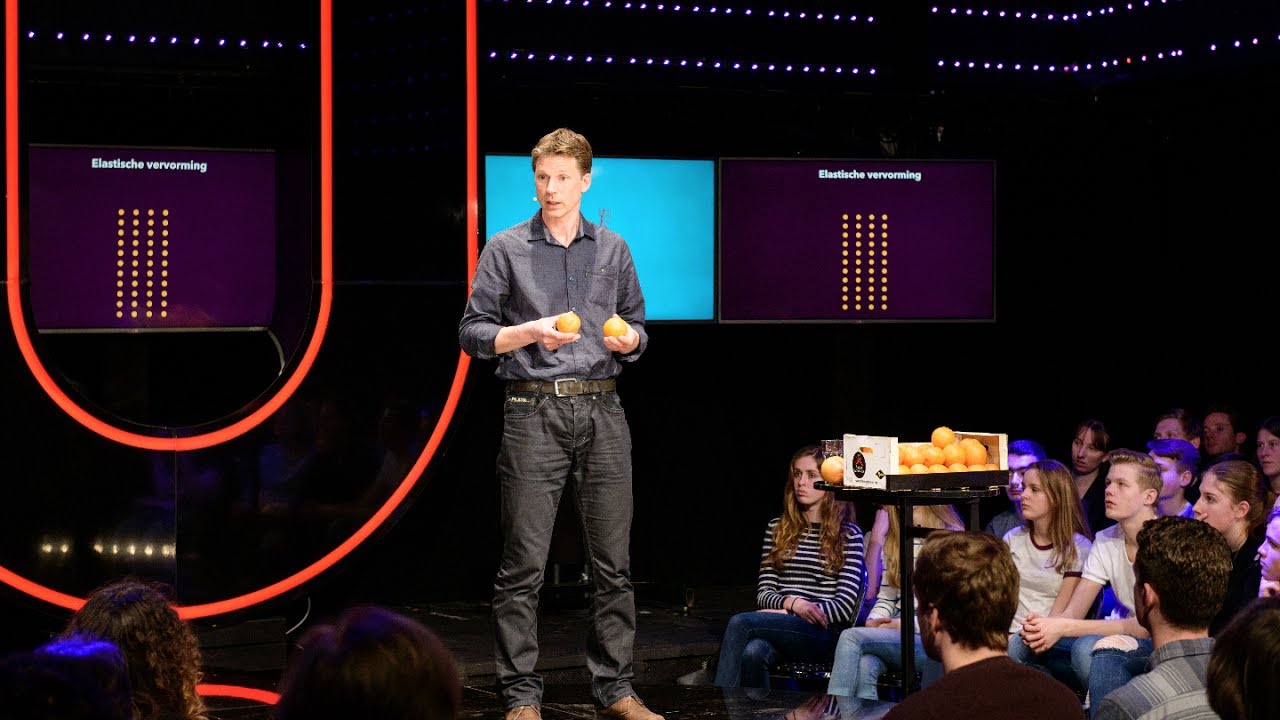
Lead organization
dr. ir. T.C. Bor
Ton Bor is an associate professor in the Production Technology chair of the Engineering Technology faculty. He received his master degree on Materials Science with honors in 1994 on the topic of solid-state welding of ceramics in the Welding Technology group (prof. G. den Ouden) of the Technical University of Delft. Then, he continued at this university with a PhD in the sections Physical Chemistry of the Solid State (prof. E.J. Mittemeijer) and Micromechanics of Materials (prof. E. van der Giessen) on strain fields in crystalline solids. After completion of the PhD in 2000, he continued his stay in both sections with a post-doctoral research. Then, he moved for two years to Malvern/Panalytical in Almelo to work as an X-ray diffraction specialist. In 2004 he started as an assistant professor in the Production Technology chair of Remko Akkerman. His research interest covers various areas including fiber reinforced composite materials, X-ray and mechanical analysis of crystalline materials, microstructural modeling of metals and alloys, and healing of ceramic materials. Solid-state additive manufacturing of aluminium has become one of the major topics (FSEAM).
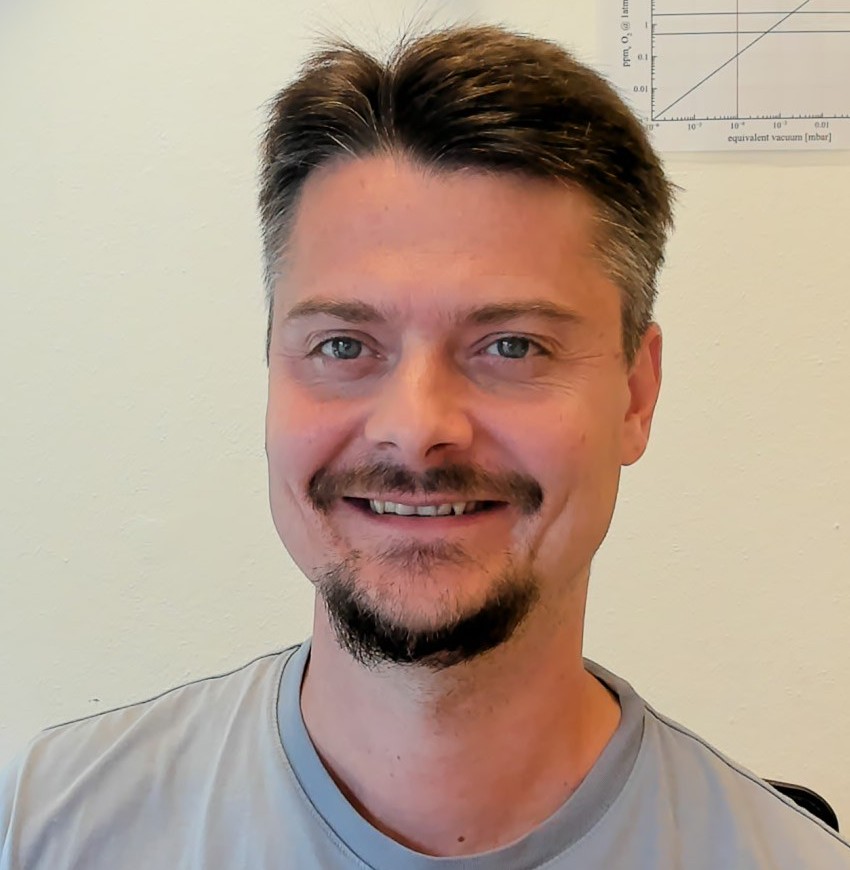
dr. ir. M. Luckabauer
Martin Luckabauer is an assistant professor in the Production Technology group at the University of Twente. He holds a BSc in Engineering Physics and an MSc in Advanced Materials Science from Graz University of Technology, Austria, and obtained his PhD with distinction in Materials Physics (Graz, 2014) on the physical fundamentals of bulk metallic glasses. As a postdoc in Graz, he developed and built a laser-interferometry-based high-stability dilatometer for nm-accuracy isothermal studies of multi-stage precipitation in complex aluminium alloys. As a research fellow at Tohoku University (Sendai, Japan), he built a superconducting electromagnetic acoustic resonance spectrometer to investigate anelastic relaxation and non-diffusive phase transformations in beta-titanium and shape-memory alloys. Since 2019 at UT, his research has focused on advanced titanium and refractory alloys and on novel solid-state additive manufacturing routes for aerospace-grade aluminium.”
Friction Stir Welding and Processing 2027
 Registration website for Friction Stir Welding and Processing 2027
Friction Stir Welding and Processing 2027fswp-2027@utwente.nl
Friction Stir Welding and Processing 2027fswp-2027@utwente.nlhttps://www.fswp2027.nl
2027-06-23
2027-06-25
OfflineEventAttendanceMode
EventScheduled
Friction Stir Welding and Processing 2027Friction Stir Welding and Processing 20270.00EUROnlineOnly2019-01-01T00:00:00Z
To be announcedTo be announced